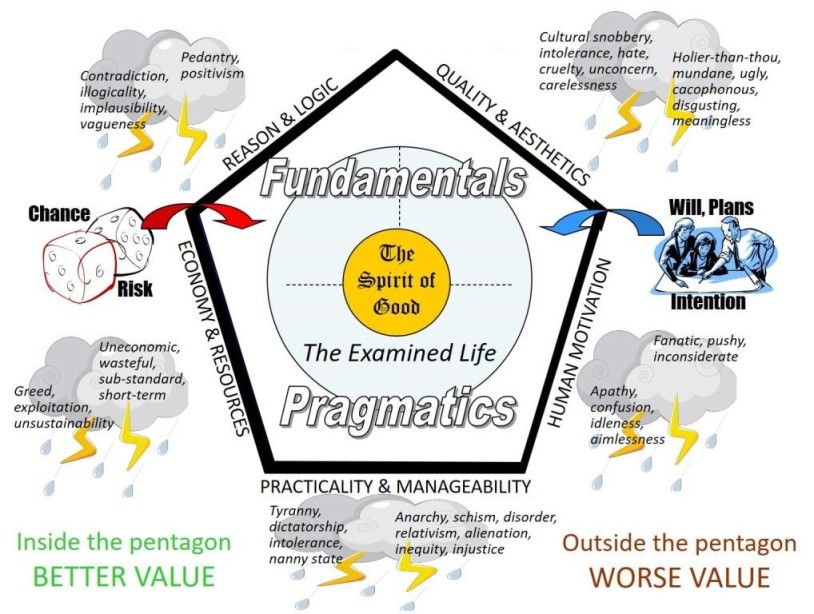
This aspect of the Pentagon is the ultimate test of practicality. We may apply reason and logic, we may check we have the resources and that the idea makes sense economically, We may make allowances for risks, both known and unknown. But if humans are involved in getting things to happen, we need to consider the factors of society and culture, and we need to keep our idea on track and to fix things if problems arise.
|
The concern here is not so much with individual humans, but whether the conditions are such that individuals can and will work together towards a goal. The goal may be either stability, or progress toward a better state of affairs.
One critical factor is whether groups of people can be well managed. Examples of such groups are societies, companies, armies, navies, merchant ships’ crews, ports, cities, and nations. Projects which can affect such groups include projects such as building or information systems, law changes, introducing tax changes. Relief from disasters such as epidemics, floods, fires, earthquakes and wars should also be considered.
This aspect includes the creation and updating of codes of conduct, which are laws and moral standards that are necessary for continuation of a good society. There may need to be laws and standards that apply to each village, town, city or nation; to an army, navy or trading company; to a games competition; to a religious sect, and to a government. Transparent systems should be adopted for commerce, government, security and the process of justice itself.
All individual persons should regard themselves as having a contract to respect the rules of the groups to which they belong. However it is the responsibility of leaders and authorities to ensure that the rules are fair and that they are enforced fairly. There should not be groups who enjoy exemption or special privileges. The rules should ideally be stable, and for the benefit of all; and not too intrusive into people’s individual freedom. Rules may need to be changed to reflect changing circumstances. Any changes to rules are invalid if the consent of both the governed and the authorities is not considered. Disregard for rules or standards is generally to be regarded as a crime. Bending of rules, whether by individuals or authorities, is also potentially a crime.
Beyond the borders of this side of the Pentagon lie chaos, anarchy, schism, inequity, injustice, and alienation. There is also utopianism and fundamentalist political collectivism, where the individual’s interests are deemed to matter very little. At the opposite extreme there can be excessive relativism, where any one view is just as good as any other. There is also tyranny and dictatorship; also intolerance, such as may be imposed by too strongly organized religion. Other undesirable situations include bribery and corruption, vendettas, and internal wars between classes or parties. There is also the danger of micromanagement or a nanny state, where the company or nation’s government intervenes too closely and at too low a level in things best left to sort themselves out.
A critical balance has to be struck between authority and personal volition. In some companies, cultures and nations the theme is that there should be just one authority, and that different opinions should be suppressed. In others, alternative views can be held, and if most humans involved think that the authority currently in charge is not doing things well, they can vote to replace it with a different team. Both styles have advantages and disadvantages. In authoritarian environments, individuals may lack motivation to do their best, but perhaps bickering over details is reduced. In democratic styles key decisions may get blocked by party antipathies, but at least the authorities have a rein on ithem,stopping them going too far against people's wishes.
See also my essay on good values for society.
| The Aspect of Quality and Aesthetics | The Aspect of Reason and Logic | The Aspect of Economy and Resources | The Aspect of Society and Manageability | The Aspect of Human Motivation |
The links below lead to the components of PLOVER
| Brief intro (narrow screen) | Philosophy | Language | Ontology | Value | Evolution | Religion |
| Fuller intro (wide screen) | Philosophy | Language | Ontology | Value | Evolution | Religion |
Links to indexes and home pages
| Index of Roger's essays | Index of Roger's book highlights | Back to Roger's Re-think home | Back to tagg.org website |
Some of these links may be under construction – or re-construction.
This version updated on
14